
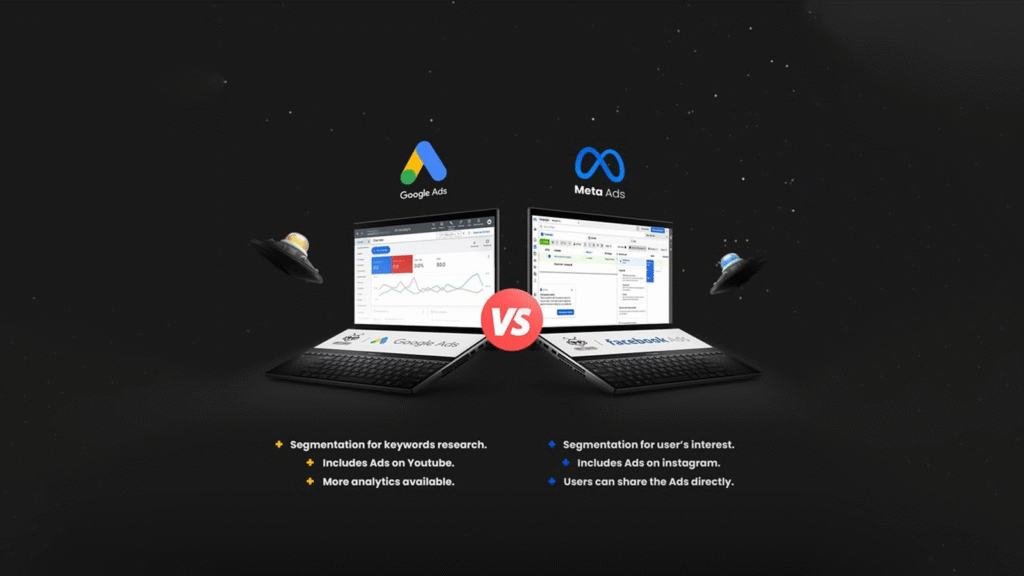
Paid ads have become a go-to for many businesses in this digital era. Whether you have a new startup or are already an established business, paid ads can make or break your business. But one question is where many businesses got stuck: whether to prioritise Facebook ads or Google ads.
In this guide, we’ll guide you on the main differences between both and what can suit your business. Understanding these pointers can not only help you make the right choices but can also help increase the revenue of your business.
Table of Contents
- Understanding the Core Difference
- Cost & ROI Considerations
- Ad Formats & Creative Flexibility
- Funnel Stage Effectiveness
- Analytics, Tracking & Optimization
- Which Industries Benefit Most from Each?
- Should You Use Both Together?
- Conclusion
- FAQs
Understanding the Core Difference
At the very core, the major difference between Facebook and Google Ads is intent vs. interest.
When someone searches “best running shoes near me” on Google, they’re already in buying mode. They have intent, which Google’s algorithm understands, and let the shoe sellers show their top items, which they promoted via Google Ads. That’s why Google Ads are also known as demand capture marketing.
Facebook Ads, on the other hand, are entirely different. Users, during the time of scrolling their newsfeeds, posts, or videos, will get to see ads in between. Who will see which type of ads is determined based on demographics, hobbies, and online behavior. Facebook helps brands create demand. You may not be thinking about new sneakers, but after seeing a sleek ad in your feed, you suddenly consider buying a pair.
So, if you want to be more precise, you should choose Google Ads. If you are okay with letting people see ads who are not entirely in the mood to buy, you can go with Facebook Ads.
Cost & ROI Considerations
For the cost, businesses often want a clear answer on which is cheaper. But unfortunately, the answer is “it depends.”
Facebook Ads are generally more affordable for campaigns focused on awareness and engagement. You might pay lower CPMs (cost per thousand impressions) and see solid interaction with visuals and videos. However, clicks don’t always mean immediate conversion, especially if your product requires some consideration before purchasing it.
Google Ads, particularly search campaigns, typically have higher CPCs (cost per click) because of competitive keyword bidding. But those clicks usually come from people closer to making a purchase decision, which can lead to higher ROI despite the higher upfront cost.
The key factor here is not cost alone, but what your goal is. A lifestyle brand launching a new product line may see great value in Facebook’s storytelling value, while a local service provider might rely on Google Ads to get high-intent leads.
Ad Formats & Creative Flexibility
While both platforms offer different ad formats, but the way the audience consumes the content is very different.
Facebook Ads are highly visual, with ad formats including image ads, video ads, carousels, stories, and even reels. This variety makes Facebook ideal for the brand that wants to promote their product in a captivating way, by persuading the user to stop on their ad while scrolling.
Google Ads, on the other hand, are focused heavily on context. The most popular format is a search ad, which is a text-based ad that appears when searching for something. Apart from that, Google also provides banner-style format, video ad options for YouTube, and shopping ads for e-commerce products.
Funnel Stage Effectiveness
One of the smartest ways to compare Facebook and Google Ads is by looking at where they perform best in the sales funnel.
- (Awareness): Facebook is clearly a better choice in the awareness stage. The platform’s visual and storytelling-driven ads are ideal for introducing a brand to people who may not be familiar with it yet.
- (Consideration): For consideration, both platforms are good to go with. Facebook can retarget engaged audiences with tailored content, while Google can capture those searching for comparisons, reviews, or information.
(Conversion): For the conversion side, Google is clearly the winner. The platforms’ search ads specifically target people who are ready to buy, sign up, or take action.
Analytics, Tracking & Optimization
One of the biggest differences between Facebook Ads and Google Ads is in how you can track and optimize the performance of the running ads.
With Facebook Ads Manager, you will get metrics like impressions, engagement, reach, and conversions. The Facebook Pixel is crucial here, as it tracks visitors across websites to refine targeting, retargeting, and lookalike audiences. Which sometimes can make its precision a bit critical, with privacy updates of Android and iOS
On Google Analytics, the Ads dashboard gives you a complete view of user journeys, from the first click to final purchase. Key metrics here include (click, CTR, conversion rate, CPC), which can help businesses understand exactly where ROI comes from.
Which Industries Benefit Most from Each?
- Google Ads ideally works best for local services (plumbers, dentists, legal services), e-commerce stores with high-intent products, and B2B businesses where prospects are actively searching for solutions. The search-based ads, which are backed by proper intent, made it ideal for such brands to run their ads.
- Facebook Ads, on the other hand, is the best for lifestyle brands, fashion retailers, entertainment, and other community-driven niches. Here, visuals and storytelling create emotional connections, which lead to either purchases or long-term brand affinity.
Hybrid industries such as travel, fitness, and SaaS startups can benefit from using both. For example, a fitness app may use Facebook to inspire users with success stories and then rely on Google to get the user from search queries like “best workout app.”
Should You Use Both Together?
No doubt that many businesses start by asking, which platform should they choose, Facebook or Google? First, you should stop taking them as competitions. Facebook can help you create more demand and let the creative side of your business thrive with visual ads. Google can help you convert individuals who are already convinced and ready to make a final decision.
A smart approach in this case would be to go with both. Instead of spending all the budget on one platform, try using a 50-50 approach or at least 60-40 with 70-30 in some scenarios. Give the platform more budget so that your brand can get the best results. Not to forget, what your expectations from the ad are, also plays a huge role in how you will measure the success in this case.
Conclusion
At the end of the day, one thing is certain: there is no one winner in Google Ads vs Facebook Ads, as it entirely depends on what your business goals are and what industry you are in.
From community building and creating more interest and hype, Facebook can be good, while for the final purchase decision, Google ads can do wonders. At the same time, it’s also important to keep in mind that brands have achieved success from promoting their business on both platforms, so it entirely depends on how you make and plan your ad material.
And if you didn’t have an in-house team, you can hire a marketing agency like us, Green Tech Ventures, where we have experts running ads for various businesses and giving them positive responses from the audience.
FAQ
FAQs about Web & App Development
Looking to build or improve your website or app?
Implementing strong authentication and encrypting sensitive data are the two most critical steps to take.
Ideally, web apps should undergo security testing with every major update.
Authentication verifies who a user is (e.g., login credentials), while authorization determines what they can access (e.g., admin vs. regular user permissions).
Encryption is vital, but it is not enough on its own. You also need secure coding practices, strong authentication, and careful monitoring overall.