
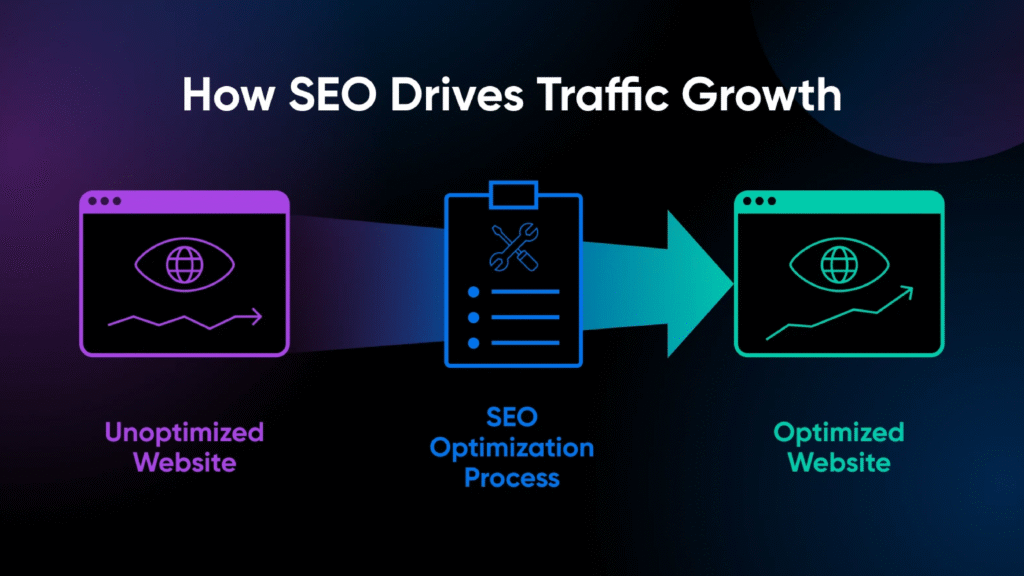
Launching a new website is an exciting thing, as you’ve promised to invest time and effort into bringing your vision to life. But no matter how stunning your design or valuable your content, your site won’t reach its audience without proper on-page SEO. It is up to search engines to determine whether or not your content is valuable enough to rank on the search engine results page (SERP).
In this guide, we’ll break down actionable strategies that even beginners can follow to rank their website on Google.
Table of Contents
- What is On-Page SEO?
- Keyword Research for New Websites
- Optimizing Title Tags and Meta Descriptions
- Crafting SEO-Friendly URLs
- Content Optimization
- Optimizing Headings and Subheadings (H1-H6)
- Image Optimization for SEO
- Internal Linking Strategy
- Mobile-Friendliness and User Experience
- On-Page SEO Checklist for New Websites
- Conclusion
- FAQs
What is On-Page SEO?
On-page SEO means optimizing your website so search engines can rank your content accordingly. Unlike off-page SEO, which focuses on backlinks and external signals, or technical SEO, which includes factors like site speed and crawlability, on-page SEO is about what users see and interact with directly.
For new websites, on-page SEO is even more important, because neither such sites have any organic traffic nor any authority. That’s why on-page SEO for new sites is more important, because every optimized page increases your chances of ranking on SERP. Without that, search engines won’t properly index your site, which in turn only reduces the chance of your site getting ranked higher on Google.
Keyword Research for New Websites
Every successful website’s base starts with keyword research. Keywords, in short, are the terms that people search for. You can find keywords according to your niche using tools like SEMrush, UberSuggest, Moz, and many more.
The first thing is to understand search intent. Are you planning to write content on information-based or transaction-based commercial keywords? For a new website, it is recommended to target low-competition keywords, which are not under the radar of high-authority sites. So, instead of targeting terms like “shoes” or “SEO”, write content on “why should I invest in top-quality shoes?” “Underrated SEO strategies for start-ups to rank higher”. Which you will find out through research.
Many keyword research tools, like SEMrush, even give a keyword difficulty metric, ranking how difficult it is to rank for this specific keyword. For new websites, it is ideal to go for keywords with 1 to 20 KD to get the most out of that keyword and rank higher.
Optimizing Title Tags and Meta Descriptions
To optimize your website properly for on-page seo, your title tags and meta descriptions are the first things search engines and visitors notice.
Title tags should include your primary keyword near the beginning, stay under 60 characters, and clearly describe the page’s content. For example:
- Weak title: “Home”
- Optimized title: “Affordable Leather Jackets for Men | ‘Brand Name’ Official”
Meta descriptions, on the other hand, directly affect rankings. They are an under-160-character description of the page, which should include your seed keyword. Instead of using unclear descriptions like “Welcome to our website,” highlight the value by using something like “Discover expert on-page SEO tips to help new websites rank faster and attract more traffic.” Most people make the mistake of adding too many keywords, which also hurts the ranking, and you should avoid that.
Crafting SEO-Friendly URLs
Your website’s URLs may seem like a small detail, but they play a big role in both user trust and search engine rankings. An SEO-friendly URL is short, descriptive, and easy to understand at a glance. Compare these two examples:
- Bad URL: www.example.com/page?id=12345
- Good URL: www.example.com/seo/on-page-seo-tips
Notice how the second URL clearly informs users (and Google) about the page’s content. Using hyphens rather than underscores, ignoring stop words like “and,” “the,” and “of,” and keeping a consistent structure are all examples of best practices.
Content Optimization
Content is the base of on-page SEO. Without high-quality, relevant content, even the best optimization techniques won’t be beneficial.
Start by placing your primary keyword strategically in the title, in one or two subheadings, the first 100 words, and naturally throughout the content. However, make sure not to stuff your keywords, as it will give Google a signal that you are trying to manipulate the rankings, which can harm your website’s ranking.
To enhance depth, use semantic keywords (also known as LSI keywords). For example, a blog about “on-page SEO” might naturally include related terms like “meta tags,” “keyword research,” or “internal linking.” These give search engines more context about your topic.
Optimizing Headings and Subheadings (H1-H6)
Headings structure your content, and make it easy for both readers and search engines to crawl your page.
Your H1 tag of the page is the main title, which should also have the seed keyword. Then, you should use H2 and H3 to properly organize your page. For example:
- H1: Complete Guide: On-Page SEO for New Websites
- H2: Keyword Research for New Websites
- H3: Using Long-Tail Keywords
This structure improves both SEO and user experience by creating a logical flow of information. Avoid using multiple H1 tags or skipping heading levels, as it confuses crawlers and readers.
Image Optimization for SEO
Keep in mind that images make content more engaging. And if not added or not optimized properly, it can hurt your ranking. What you need to understand is that search engines can’t see images; they rely on the alt text you provide. At the same time, alt text helps make this picture usable for visually impaired visitors to understand what’s in this picture.
Another key factor is file size. Large images load slowly, which impacts your site’s overall speed, which can impact your ranking. So, make sure to always optimize your image using modern formats like WebP, without losing image quality. When images are properly optimized, your website will load faster, which can help you rank higher on SERP.
Internal Linking Strategy
Internal linking is an underrated strategy for on-page seo, which most people seem to ignore these days, but if done strategically, it can benefit a lot of pages on your site. By connecting one page with another, you give your visitors a guide to other pages, which will surely keep visitors on your site, giving Google a positive view of your site.
Not only that, but an effective internal linking strategy also improves crawlability (so search engines discover more pages) and enhances user engagement by reducing bounce rate. For example, linking a blog about “on-page SEO” to another article on “keyword research” creates a natural content journey.
Mobile-Friendliness and User Experience
With Google’s mobile-first indexing, your website’s mobile version is now the primary reference point for search rankings. This makes mobile-friendliness a must for on-page SEO.
Make sure to have a responsive design that adapts to every screen size. Apart from that, make sure to focus on page speed and core web vitals, factors like loading performance and visual stability, that Google uses to measure user experience.
For new websites, starting mobile-first ensures you’re aligned with Google’s expectations from day one.
On-Page SEO Checklist for New Websites
Here is a basic, but important, on-page SEO checklist for a new website:
- Title tags optimized with primary keywords.
- Having an informative meta description.
- Short and scannable URLs.
- Quality content without stuffing keywords.
- Properly structured headings (H1–H6).
- Optimized images with alt texts.
- Strong internal linking strategy.
- Mobile-friendly design with fast loading speeds.
- Schema markup for rich SERP features.
Conclusion
If you want your website to do well on Google, On-page SEO is an essential element that you should take great care of. Because without a bad on-page seo practice, no matter how great your content is, it will not be ranked on Google.
Above, we’ve shared some important pointers to take care of if you want your on-page SEO to perform well. If you follow those steps, you will surely see your site gaining organic traffic.
Lastly, at Green Tech Ventures, we help brands like yours implement smart SEO strategies that drive visibility, traffic, and results.
FAQ
FAQs about SEO
Looking to build or improve your website or app?
The first step is keyword research. Try to find long-tail keywords that have a high volume and are low in difficulty.
Ideally, go for 2-3 related terms.
Yes, indeed, meta descriptions affect page rankings.
Typically, you can expect to wait around 3-6 months to see results.
While on-page SEO is important, you also need to take into account off-page seo and technical seo.